Showing posts with label Mechanical Engineering Location & Physical Work. Show all posts

March 15, 2026

Reason #74: Outside the Clusters, You Don't Exist

You type your city into a job board and filter for mechanical engineering. Three results come back. One is HVAC service. One is a six-month contract an hour and a half away. One was posted nine weeks ago and the listing has not been updated since. You refine the search. You widen the radius. You check a second board. The results do not improve. You are not in a bad market. You are in no market at all.

There are roughly 281,000 mechanical engineering jobs in the United States (Bureau of Labor Statistics [BLS], 2024a). See Reason #34. More than half of them are in ten states. Michigan alone holds over 32,000. The Detroit metro area employs more than 20,000 mechanical engineers, one for every hundred workers in the region. Washington, D.C., the capital of the country, employs roughly 500 (BLS, 2024b). New York City, the largest labor market in the nation, has a mechanical engineering location quotient of 0.29 (BLS, 2024a). That means for every mechanical engineer you would expect to find based on national averages, New York has fewer than one in three. You are not scarce there. You are a rounding error.
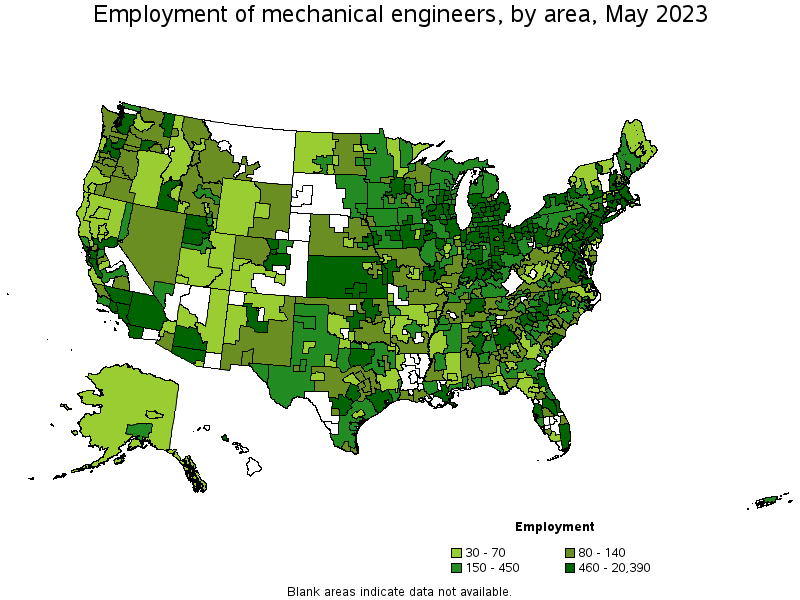
BLS map of mechanical engineer employment by metro area, May 2023, showing heavy concentration in a handful of industrial regions and minimal presence across most of the country.

Source: Bureau of Labor Statistics, OEWS May 2023. Mechanical Engineers (17-2141).

The numbers behind the map are worse than the colors suggest. Five states account for over 40 percent of every mechanical engineering job in the country. Michigan leads with a location quotient of 4.05, meaning it has four times the national average concentration of MEs. California, the largest state economy, has a location quotient below 1.0. It is actually underrepresented in mechanical engineering jobs relative to its size.

Table 1. ME Employment by Top States (May 2023 OEWS)

State ME Jobs Location Quotient % of U.S. ME Total
Michigan 32,580 4.05 11.6%
California 27,420 0.82 9.8%
Texas 19,630 0.78 7.0%
Pennsylvania 19,060 1.73 6.8%
Ohio 15,160 1.50 5.4%
Top 5 subtotal 113,850 40.5%
Remaining 45 states + D.C. ~167,000 ~59.5%
U.S. total (ME) ~281,000 100%

Source: Bureau of Labor Statistics, OEWS May 2023. SOC 17-2141. Location quotient measures local concentration relative to the national average (1.0 = average). Five states hold over 40 percent of all ME jobs.

The map gets worse when you compare it to other fields. California employs 27,420 mechanical engineers. It also employs 304,390 software developers (BLS, 2024c). That is an 11-to-1 ratio in a single state. Nationally, there are nearly six software developers for every mechanical engineer. Software and computer occupations have telework rates near 65 percent (BLS, 2023a). Mechanical engineers sit closer to 26 percent (BLS, 2023b). See Reason #30. A software developer in Boise or Raleigh or Omaha can work for a company in San Francisco without moving. You cannot test a casting from your living room. You cannot run a DV plan from a home office in a city that has no test lab, no prototype shop, and no OEM within two hundred miles. Your work is physical, your employers are clustered, and the gap between those two facts is your career.

Table 2. ME vs. Software Developer Employment, Top States (May 2023 OEWS)

State ME Jobs Software Dev Jobs Ratio (SW : ME)
California 27,420 304,390 11.1 : 1
Texas 19,630 138,510 7.1 : 1
Washington 89,110
Virginia 86,680
New York 105,460
U.S. total ~281,000 1,656,880 5.9 : 1

Source: Bureau of Labor Statistics, OEWS May 2023. ME = SOC 17-2141. Software developers = SOC 15-1252. — = state not in top 5 for ME employment; full state data available in BLS downloadable files. Washington, Virginia, and New York each employ more software developers than the top ME state (Michigan) employs mechanical engineers. California alone employs 304,390 software developers. The entire U.S. mechanical engineering workforce is roughly 281,000.

If you zoom in further, the concentration gets more extreme. The metro areas with the highest ME location quotients are not coastal cities or tech hubs. They are manufacturing corridors. Columbus, Indiana, a city built around one company, has a location quotient of 26.54. That means it has over 26 times the national average concentration of mechanical engineers. Three of the top five metros are in Michigan. These are the places where your career lives. If you are not in one of them, you are reading job boards with three results.

Table 3. Top Metro Areas for ME Concentration (May 2023 OEWS)

Metro Area ME Jobs Location Quotient Mean Wage
Columbus, IN 1,340 26.54 $117,070
California-Lexington Park, MD 680 14.48 $110,700
Waterloo-Cedar Falls, IA 1,010 11.68 $108,150
Saginaw, MI 870 10.99 $93,530
Detroit-Warren-Dearborn, MI 20,390 10.73 $102,870
Huntsville, AL 2,260 8.99 $111,780
Ann Arbor, MI 1,910 8.85 $108,980
New Bern, NC 350 7.79 $88,280
Fond du Lac, WI 300 6.69 $101,100
Bremerton-Silverdale, WA 600 6.49 $102,710

Source: Bureau of Labor Statistics, OEWS May 2023. SOC 17-2141. Sorted by location quotient. Columbus, IN (Cummins headquarters) has over 26 times the national average concentration of MEs. Outside of Detroit, the highest-concentration metros employ fewer than 2,300 mechanical engineers each. These are not cities you dream of moving to. They are cities where one employer decides whether your career exists.

Outside the top ten states, the remaining 120,000 or so mechanical engineering jobs are scattered across forty states, territories, and the District of Columbia. In many of those states, the entire ME workforce is measured in the low hundreds. In some states, the entire mechanical engineering workforce is smaller than the accounting department at a mid-size company. If you live in one of those states and want to stay, your options are not limited. They are functionally zero. The job that exists is the job you take, on the terms it offers, because there is no second offer coming from across town.

This is why the advice to "just relocate" misses the point. You can relocate. Many do. But you are not relocating to a city. You are relocating to a plant, or a cluster of plants, in a region you did not choose, for a program that may not outlive your mortgage. See Reason #20. Look at Table 3 again. Outside of Detroit, the highest-concentration metros each employ fewer than 2,300 MEs. Saginaw has 870. Fond du Lac has 300. You are not moving to a labor market. You are moving to a plant. And when that program ends, you do not get to search locally. You search the map again, the same short list of metros with the same short list of employers, and you ask your family to move again.

The map has always looked like this. Nobody shows it to you before you declare the major.


References:

Bureau of Labor Statistics. (2023a, December 19). About 1 in 3 workers in management, professional, and related occupations teleworked in November 2023. The Economics Daily. https://www.bls.gov/opub/ted/2023/about-1-in-3-workers-in-management-professional-and-related-occupations-teleworked-november-2023.htm

Bureau of Labor Statistics. (2023b). Occupational requirements survey: Mechanical engineers. https://www.bls.gov/ors/factsheet/mechanical-engineers.htm

Bureau of Labor Statistics. (2024a). Occupational employment and wage statistics, May 2023: Mechanical engineers (17-2141). https://www.bls.gov/oes/2023/may/oes172141.htm

Bureau of Labor Statistics. (2024b). Occupational employment and wage statistics, May 2023: District of Columbia. https://www.bls.gov/oes/2023/may/oes_dc.htm

Bureau of Labor Statistics. (2024c). Occupational employment and wage statistics, May 2023: Software developers (15-1252). https://www.bls.gov/oes/2023/may/oes151252.htm

Aerial view of Hashima Island, an abandoned industrial settlement surrounded by open ocean, its concrete buildings decaying with no inhabitants remaining.

March 12, 2026

Reason #66: Your Personal Life Is an Employer Subsidy

You move for the job. You leave behind a person, a city, a proximity to family that you will not get back on this timeline. You do it because mechanical engineering is a physical discipline and the openings are where the plant is, not where your life is. See Reason #20. You tell yourself it is temporary. It is not temporary. The next role is in another plant town chosen by rail access and tax abatements, and the one after that is wherever your sub-specialty still has funding. See Reason #11.

Other engineering branches do not extract this. A software engineer negotiates remote before accepting the offer. An EE in chip design can work from a dozen metros with active semiconductor clusters, most of them places people actually want to live. A CS grad picks a coast and stays on it. You pick the job and the job picks your zip code, your commute, your weekend radius, and by extension, the pool of people you will meet, date, befriend, and rely on for the next several years.

The entry ramp makes it worse. The internships that qualify you for entry-level are in the same plant towns, on the same shift schedules, demanding the same uprooting. See Reason #57. You vanish for a summer, then vanish again for the first job. The people you left behind adjust to your absence. Some wait. Many do not. You learn this when the distance stops being a logistics problem and starts being a verdict.

Once you are there, the schedule finishes what the geography started. ME is remote-proof. See Reason #30. The test lab, the build floor, the shaker queue, the supplier visit, the 2 a.m. line-down call. Your availability is not flexible because the hardware is not flexible. Date nights get canceled for thermal soaks. Weekends get eaten by qualification runs that could not get chamber time during the week. You are not lazy. You are tethered. And the tether is shorter than your friends in other fields will ever understand, because their jobs do not live in a building that smells like coolant.

The social cost compounds quietly. You work in rooms that skew 8:1 male. See Reason #43. Your peer network is small, homogeneous, and geographically scattered across plant towns that do not overlap. The informal connections that other professionals build through mixed workplaces, urban density, and overlapping social circles do not form as easily when your office is a manufacturing campus thirty minutes from the nearest downtown. You make friends at work because work is where you are. Then you change jobs and the friends reset because the zip code resets.

None of this shows up on a pay stub. That is the point. It is an uncompensated extraction. The company gets your proximity, your flexibility, your weekends, and your willingness to relocate. You get a salary that already trails your engineering peers. See Reason #20. The gap between what you are paid and what the job actually costs you is filled by your relationships, your geography, your time, and your health. In economics that gap has a name. It is a subsidy. You are the one paying it.

The younger version of you does not see this. The offer letter looks like a beginning, not a trade. You are twenty-two or twenty-five and the move feels like ambition. You pack the car, sign the lease, and promise everyone it is temporary. Two and a half years later the company outsources the entire engineering department, and you are standing in a town you did not choose, missing a person you did not intend to lose, holding a resume that qualifies you to do it all over again somewhere else. See Reason #46.

The brochure calls it opportunity. Your twenties call it back and get voicemail.

Rusted cars sit abandoned in desert scrubland beside a wooden post stacked with directional signs pointing to distant cities along Route 66.


January 13, 2026

Reason #52: The Plant Teaches You What the Degree Didn’t

Your first week in a real plant is an apology tour for everything you were so confident about in school. You walk in thinking "design" means clean geometry and correct equations. Then the floor hands you reality in steel-toe boots. The fastest way to learn this is to watch a technician solve your problem in five minutes, then keep solving it for the next five years. See Reason #16. And when you try to explain what you "meant," you discover your meaning does not ship. See Reason #10.

The gap is structural, not personal. Your curriculum spent its budget on canonical thermodynamics and fluid mechanics that have not changed in decades. See Reason #35. The electives that were supposed to let you specialize gave you three courses, a sampler platter, not a skill set. See Reason #41. James Trevelyan spent years studying what engineers actually do versus what they believe they do. His ethnographic research, published in the Journal of Engineering Education, found that engineers spend approximately 60 percent of their time communicating with others and less than 30 percent on solitary technical work (Trevelyan, 2007). Early-career engineers spend 50 to 70 percent of their time on direct interpersonal interactions (Trevelyan and Tilli, 2008). His 2014 book, The Making of an Expert Engineer, catalogs over 100 misconceptions that engineering students carry into the workplace. The most persistent one is that engineering is primarily about technical problem-solving rather than coordination and communication. The plant corrects that misconception in the first week.

In class, constraints are tidy and announced. In a plant, constraints arrive as a forklift turning radius, a fixture that already exists, a vendor that can only hold that tolerance on Tuesdays, and a lead time that makes your "better" material irrelevant. Your elegant part fails because it cannot be deburred without cutting gloves, because the operator cannot reach that fastener without removing two guards, because the paint line racks it by the one surface you made critical, because the packaging drop test turns your crisp edge into a warranty claim. You start noticing that the important dimensions are the ones you never thought to dimension.

A Robinson (2012) time study of 78 design engineers over 20 working days, generating 11,137 data points, found that even their "technical" work was saturated with information management. The same engineers spent 55.75 percent of their time seeking, receiving, or providing information (Robinson, 2010). The plant rewrites your sense of what "engineering" is. You spend less time proving the mechanism and more time proving it can be built, inspected, shipped, serviced, and repeated. You learn to fear ERP substitutions, revision locks, and the quiet power of a nonconformance tag. You learn that the drawing is not the truth. The process is. A perfect CAD model is just a suggestion until the gage says no and the line stops.

And the irony is you still have to act like the degree taught you this. You will talk about analysis and "design intent" while you are really negotiating with reality: cycle time, scrap rate, torque access, training burden, rework risk, and whatever the shop can actually do this week. The plant does not care what you know. It cares what you can get to ship. You might expect the employer to close the gap the university left open. They do not. Your training is a safety video and a supervisor who points at the line. See Reason #54.

You were trained to solve problems. You were hired to learn which problems you are allowed to solve.


References:

Trevelyan, J. P. (2007). Technical coordination in engineering practice. Journal of Engineering Education, 96(3), 191-204. https://doi.org/10.1002/j.2168-9830.2007.tb00929.x

Trevelyan, J. P. (2014). The making of an expert engineer. CRC Press.

Robinson, M. A. (2012). How design engineers spend their time: Job content and task satisfaction. Design Studies, 33(4), 391-425. https://doi.org/10.1016/j.destud.2012.03.002

Robinson, M. A. (2010). An empirical analysis of engineers' information behaviors. Journal of the American Society for Information Science and Technology, 61(4), 640-658.


Vintage shop-class room full of students at benches, showing skills learned by doing, not theory.

September 2, 2025

Reason #30: Remote-Proof Work

Everyone else learned to work from home. You learned where the badge reader is. In 2020 the world moved to laptops and stayed there. Mechanical engineering kept its seat in the plant, see Reason #20.

In the same year the pandemic hit, economists Jonathan Dingel and Brent Neiman classified every occupation in the United States by whether it could be performed entirely from home. They used federal O*NET work context surveys, the same database that describes what you actually do all day. Their paper has been cited nearly two thousand times. Software developers: teleworkable. Electrical engineers: teleworkable. Civil engineers: teleworkable. Aerospace, biomedical, environmental, computer hardware, electronics: all teleworkable. Mechanical engineers: not teleworkable (Table 1). The work hugs hardware (see Reason #64), and the classification caught it (Dingel & Neiman, 2020).

The distinction matters because it is not about preference. It is about structure. Electrical engineers model circuits in simulation environments that run the same on a kitchen table as in a cubicle. Civil engineers review submittals, run structural models, and stamp drawings, all of which travel over a VPN. Aerospace engineers spend their days in systems engineering tools and requirements databases. You spend yours waiting for a test chamber, chasing a supplier cert, or walking a production line to verify a first article. Your calendar follows equipment, not your preferences, see Reason #14. The Bureau of Labor Statistics does not even mention remote work as an option in its Occupational Outlook Handbook entry for mechanical engineers. For software developers, remote work is the opening line of the work environment section (BLS, 2025a; BLS, 2025b).

By the first quarter of 2024, 22.9 percent of American workers were teleworking at least part of the week. Among management, professional, and related occupations, the rate was 33.7 percent. The workers who benefited most were the ones in occupations classified as teleworkable. The ones who did not benefit were concentrated in production, transportation, construction, and the hardware-bound corners of engineering. Your corner. Remote-capable workers can live anywhere their internet reaches. You live where the plant is (see Reason #11), and the commute, the relocation, and the time lost to being physically present are costs your employer never has to reimburse (see Reason #66) (BLS, 2025c).

Hybrid promises drift back to on-site because gates, audits, and signoffs exist in places without Zoom. You can move a CAD file from a couch, but you cannot run a thermal cycle, chase a vibration, or witness a UL pre-scan from there. Suppliers still want eyes on parts, not emails about them. When timing gets tight, the question is not "Can you log in." It is "Can you be here." And oversupply keeps it that way. Employers can insist on butts in bays and still fill the role. If you cannot make second shift for a retest, someone else will, see Reason #1.

Even the mechanical drafter, the person who draws what you engineer, was classified as teleworkable (Table 1). Your downstream output can be produced remotely. You cannot.

Data Tables

Table 1. Teleworkability Classification by Engineering Discipline

Occupation SOC Code Teleworkable
Software Developers 15-1132 Yes
Electrical Engineers 17-2071 Yes
Electronics Engineers 17-2072 Yes
Computer Hardware Engineers 17-2061 Yes
Civil Engineers 17-2051 Yes
Aerospace Engineers 17-2011 Yes
Environmental Engineers 17-2081 Yes
Biomedical Engineers 17-2031 Yes
Mechanical Engineers 17-2141 No
Mechanical Drafters 17-3013 Yes

Source: Dingel & Neiman (2020), O*NET work context classification. Binary: 1 = can be performed entirely at home, 0 = cannot. Replication data: github.com/jdingel/DingelNeiman-workathome


References:

Dingel, J. I., & Neiman, B. (2020). How many jobs can be done at home? Journal of Public Economics, 189, 104235. https://doi.org/10.1016/j.jpubeco.2020.104235

Bureau of Labor Statistics. (2025a). Occupational Outlook Handbook: Mechanical engineers. U.S. Department of Labor. https://www.bls.gov/ooh/architecture-and-engineering/mechanical-engineers.htm

Bureau of Labor Statistics. (2025b). Occupational Outlook Handbook: Software developers, quality assurance analysts, and testers. U.S. Department of Labor. https://www.bls.gov/ooh/computer-and-information-technology/software-developers.htm

Bureau of Labor Statistics. (2025c). Telework trends. Beyond the Numbers, 14(2). https://www.bls.gov/opub/btn/volume-14/telework-trends.htm


Empty wooden pews line the floor of a small chapel, sunlight streaming faintly through the windows.

August 27, 2025

Reason #20: The Plant Picks Your Zip Code

Your specialization chose the metro. See Reason #11. Now the plant chooses the rest. You drove past cornfields, smokestacks, and a rail spur, then parked beside a building that smells like coolant and cardboard. Before lunch, a supervisor asks if you can swing by bay three. This is mechanical engineering. You are hired to be near the thing as it becomes the product.

Other engineers work on-site too. But civil engineers build in every city. Their jobsites are wherever people live. Chemical engineers run processes in refineries and pharma plants spread across dozens of metros. Electrical engineers increasingly do board layout, firmware, and signal work that lives in a laptop. Mechanical engineering gets the worst of both: the work is physical and the industries are clustered. A civil engineer can take a structural role in Portland or Pittsburgh or Pensacola. If your experience is in NVH for powertrain, you go to southeast Michigan, or you do not do NVH. The Bureau of Labor Statistics confirms the broader pattern. In the first quarter of 2024, workers in production, transportation, and material moving occupations teleworked at a rate of 3.2 percent. Management and professional occupations teleworked at 37.9 percent (BLS CPS, 2024). The BLS Occupational Outlook Handbook describes mechanical engineers as people who "generally work in offices" and "may occasionally visit worksites." Anyone who has worked in a plant knows what "occasionally" means. It means the phone rings at 2 a.m. because a test fixture drifted, a fitting is weeping, or the line stopped and nobody can find the revision that explains why.

When the vendor's motor shows up with a new flange, you adapt the mounting, update the keyway, move holes on drawings, call out threads, and rewrite the torque table so the build keeps moving. The shop does the hands-on work while you route ECOs and CAPA rationales, which is exactly why you must be present. See Reason #16. You are not building the thing. You are standing next to the people who are, writing the paperwork that lets them continue.

Oversupply makes the geography harsher. There are more mechanical engineers than attractive roles, so openings are where the plant is, not where you want to be. You take the job in a town chosen by rail access, utility capacity, and tax abatements because you cannot negotiate for remote when ten qualified applicants will move tomorrow. See Reason #1. Plants do not sit downtown. They sit in industrial parks, along freight corridors, in exurban strips zoned for noise and emissions. Your apartment options are whatever is within commuting distance of that zoning. Managers will say "we are flexible," then schedule standups around the production shift.

The irony is that the closer you are to shipping, the further you are from freedom. Your impact is real, very real, but the badge opens doors to the plant, not to a coastal remote policy. See Reason #30. A civil engineer can relocate and still be a civil engineer. You relocate and start over. The plant chooses where you live.


References:

U.S. Bureau of Labor Statistics. (2025). Telework trends in 2024. Beyond the Numbers, 14(2). https://www.bls.gov/opub/btn/volume-14/telework-trends-in-2024.htm

U.S. Bureau of Labor Statistics. (2025). Occupational Outlook Handbook: Mechanical Engineers. https://www.bls.gov/ooh/architecture-and-engineering/mechanical-engineers.htm


A lone gas station pump stands in a vast empty plain, with snow-capped mountains rising in the distance.

August 24, 2025

Reason #11: Your Specialization Dictates Where You Live

As hard as establishing a specialization in mechanical engineering is, See Reason #8, another challenge that comes up is how that specialization quietly chooses your address. The first real job gives you a niche. After that, the niche gives you a handful of ZIP codes. Not states. Counties.

The Bureau of Labor Statistics and industry data make this concrete. Three counties, Los Angeles, King County (Seattle), and Snohomish County (Everett), account for one-fifth of all U.S. aerospace products and parts manufacturing employment (BLS, 2023). If your résumé reads airframe structures or turbine metallurgy, your apartment search starts there. Texas holds roughly half the entire national oil and gas extraction workforce, and Harris County alone, Houston, holds 23.6 percent of all U.S. oil and gas well drilling employment (BLS, 2025). If your niche is pipeline stress analysis or rotating equipment for upstream, you learn the Beltway 8 toll schedule whether you wanted to or not. Michigan's location quotient for automobile manufacturing is 7.9, nearly eight times the national concentration, and transportation equipment accounts for 25.8 percent of Indiana's entire manufacturing workforce (BLS QCEW, 2022). NVH, powertrain calibration, chassis dynamics: Detroit and its satellites, or nothing.

It does not stop at the obvious ones. Minnesota's electromedical device manufacturing concentration is 9.9 times the national average, with 530 establishments employing over 34,500 people (Lightcast, 2023). If you specialize in medical device design, tolerance analysis on implantables, or cleanroom fixture work, your industry lives in the Twin Cities. GE Vernova's Greenville, South Carolina facility is the largest gas turbine manufacturing plant in the world, 1.7 million square feet, employing over 3,600 people and shipping 3,300 turbines since 1968 (Turbomachinery Magazine, 2024). If your career is in gas path thermal analysis or hot section components, Greenville is not a suggestion. It is the address. Huntington Ingalls Industries employs over 25,000 in Newport News, Virginia and over 11,000 in Pascagoula, Mississippi. They are the sole builder of U.S. Navy nuclear aircraft carriers and one of two providers of nuclear submarines. If your specialization is naval marine engineering, your options are two shipyards on two coastlines. Caterpillar, Komatsu, and John Deere all operate major plants in the Peoria-to-Moline corridor in central Illinois. In early 2018, Peoria County had the highest wage growth in the nation, driven almost entirely by machinery manufacturers (Greater Peoria EDC). If heavy equipment is your niche, your career orbits a 90-mile stretch of Interstate 74.

This would be tolerable if it only governed your commute. It does not. Your partner's career, your parents' health, your kids' school district, your hometown friendships: they all become secondary to the employer that needs your exact sub-specialty in the one region that still funds it. You can want Denver or Raleigh or anywhere with mountains and decent coffee. The postings do not care. They ask for five years in your precise corner of the field and they expect you to show up where that corner exists. Your specialization chose the metro. Your employer chooses the suburb. See Reason #20.

The longer you stay in your niche, the fewer doors open outside of it. You become experienced, which means you are hired to repeat yourself. Switching cities often means switching industries, and switching industries often means starting over. Many mechanical engineers eventually solve the problem by leaving mechanical engineering. See Reason #28.

In other fields, remote work solved this. If your deliverable is code or a model or a report, the work can follow you. Mechanical engineering is not other fields. The work is physical, plant-bound, tied to hardware you have to touch. See Reason #30. Nobody tells you this in school. They just hand you thermodynamics and call it broad.


References:

U.S. Bureau of Labor Statistics. (2023). Come fly with BLS: Aerospace products and parts manufacturing employment by county, QCEW 2022. https://www.bls.gov/blog/2023/come-fly-with-bls.htm

U.S. Bureau of Labor Statistics. (2025). Describing the U.S. oil and gas extraction workforce with public data. Monthly Labor Review. https://www.bls.gov/opub/mlr/2025/article/describing-the-us-oil-and-gas-extraction-workforce-with-public-data.htm

U.S. Bureau of Labor Statistics. (2023). A look at manufacturing jobs on National Manufacturing Day. The Economics Daily. https://www.bls.gov/opub/ted/2023/a-look-at-manufacturing-jobs-on-national-manufacturing-day.htm

U.S. Bureau of Labor Statistics. (2007). Employment concentration in automotive industries. The Economics Daily. https://www.bls.gov/opub/ted/2007/jul/wk4/art03.htm

Minnesota Department of Employment and Economic Development. (2023). Life sciences industry data. https://mn.gov/deed/dobusiness/key-industries/leading-life-sciences/

Turbomachinery International. (2024). Turbo tour: GE Vernova's gas turbine manufacturing facility. https://www.turbomachinerymag.com/view/turbo-tour-ge-vernova-s-gas-turbine-manufacturing-facility

Huntington Ingalls Industries. (2023). Careers. https://hii.com/careers/


A covered wagon with yellow wheels sits against a fiery sunset sky, overlooking open plains and distant hills.

Reason #75: It's a Vocation Wearing a Profession's Suit

You took the same calculus sequence as the pre-med students. You took the same physics as the future physicists. You survived thermodynamics...