You type your city into a job board and filter for mechanical engineering. Three results come back. One is HVAC service. One is a six-month contract an hour and a half away. One was posted nine weeks ago and the listing has not been updated since. You refine the search. You widen the radius. You check a second board. The results do not improve. You are not in a bad market. You are in no market at all.
There are roughly 281,000 mechanical engineering jobs in the United States (Bureau of Labor Statistics [BLS], 2024a). See Reason #34. More than half of them are in ten states. Michigan alone holds over 32,000. The Detroit metro area employs more than 20,000 mechanical engineers, one for every hundred workers in the region. Washington, D.C., the capital of the country, employs roughly 500 (BLS, 2024b). New York City, the largest labor market in the nation, has a mechanical engineering location quotient of 0.29 (BLS, 2024a). That means for every mechanical engineer you would expect to find based on national averages, New York has fewer than one in three. You are not scarce there. You are a rounding error.
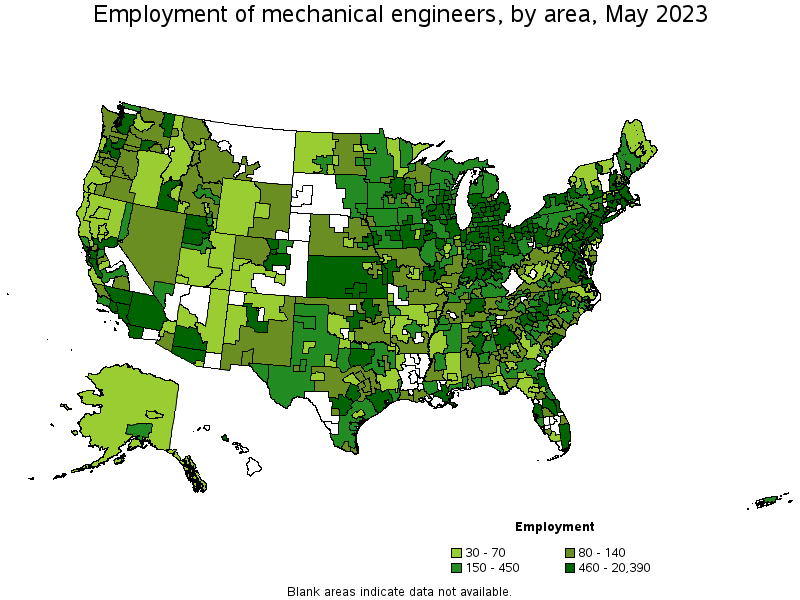
Source: Bureau of Labor Statistics, OEWS May 2023. Mechanical Engineers (17-2141).
The numbers behind the map are worse than the colors suggest. Five states account for over 40 percent of every mechanical engineering job in the country. Michigan leads with a location quotient of 4.05, meaning it has four times the national average concentration of MEs. California, the largest state economy, has a location quotient below 1.0. It is actually underrepresented in mechanical engineering jobs relative to its size.
Table 1. ME Employment by Top States (May 2023 OEWS)
| State | ME Jobs | Location Quotient | % of U.S. ME Total |
|---|---|---|---|
| Michigan | 32,580 | 4.05 | 11.6% |
| California | 27,420 | 0.82 | 9.8% |
| Texas | 19,630 | 0.78 | 7.0% |
| Pennsylvania | 19,060 | 1.73 | 6.8% |
| Ohio | 15,160 | 1.50 | 5.4% |
| Top 5 subtotal | 113,850 | 40.5% | |
| Remaining 45 states + D.C. | ~167,000 | ~59.5% | |
| U.S. total (ME) | ~281,000 | 100% |
Source: Bureau of Labor Statistics, OEWS May 2023. SOC 17-2141. Location quotient measures local concentration relative to the national average (1.0 = average). Five states hold over 40 percent of all ME jobs.
The map gets worse when you compare it to other fields. California employs 27,420 mechanical engineers. It also employs 304,390 software developers (BLS, 2024c). That is an 11-to-1 ratio in a single state. Nationally, there are nearly six software developers for every mechanical engineer. Software and computer occupations have telework rates near 65 percent (BLS, 2023a). Mechanical engineers sit closer to 26 percent (BLS, 2023b). See Reason #30. A software developer in Boise or Raleigh or Omaha can work for a company in San Francisco without moving. You cannot test a casting from your living room. You cannot run a DV plan from a home office in a city that has no test lab, no prototype shop, and no OEM within two hundred miles. Your work is physical, your employers are clustered, and the gap between those two facts is your career.
Table 2. ME vs. Software Developer Employment, Top States (May 2023 OEWS)
| State | ME Jobs | Software Dev Jobs | Ratio (SW : ME) |
|---|---|---|---|
| California | 27,420 | 304,390 | 11.1 : 1 |
| Texas | 19,630 | 138,510 | 7.1 : 1 |
| Washington | — | 89,110 | |
| Virginia | — | 86,680 | |
| New York | — | 105,460 | |
| U.S. total | ~281,000 | 1,656,880 | 5.9 : 1 |
Source: Bureau of Labor Statistics, OEWS May 2023. ME = SOC 17-2141. Software developers = SOC 15-1252. — = state not in top 5 for ME employment; full state data available in BLS downloadable files. Washington, Virginia, and New York each employ more software developers than the top ME state (Michigan) employs mechanical engineers. California alone employs 304,390 software developers. The entire U.S. mechanical engineering workforce is roughly 281,000.
If you zoom in further, the concentration gets more extreme. The metro areas with the highest ME location quotients are not coastal cities or tech hubs. They are manufacturing corridors. Columbus, Indiana, a city built around one company, has a location quotient of 26.54. That means it has over 26 times the national average concentration of mechanical engineers. Three of the top five metros are in Michigan. These are the places where your career lives. If you are not in one of them, you are reading job boards with three results.
Table 3. Top Metro Areas for ME Concentration (May 2023 OEWS)
| Metro Area | ME Jobs | Location Quotient | Mean Wage |
|---|---|---|---|
| Columbus, IN | 1,340 | 26.54 | $117,070 |
| California-Lexington Park, MD | 680 | 14.48 | $110,700 |
| Waterloo-Cedar Falls, IA | 1,010 | 11.68 | $108,150 |
| Saginaw, MI | 870 | 10.99 | $93,530 |
| Detroit-Warren-Dearborn, MI | 20,390 | 10.73 | $102,870 |
| Huntsville, AL | 2,260 | 8.99 | $111,780 |
| Ann Arbor, MI | 1,910 | 8.85 | $108,980 |
| New Bern, NC | 350 | 7.79 | $88,280 |
| Fond du Lac, WI | 300 | 6.69 | $101,100 |
| Bremerton-Silverdale, WA | 600 | 6.49 | $102,710 |
Source: Bureau of Labor Statistics, OEWS May 2023. SOC 17-2141. Sorted by location quotient. Columbus, IN (Cummins headquarters) has over 26 times the national average concentration of MEs. Outside of Detroit, the highest-concentration metros employ fewer than 2,300 mechanical engineers each. These are not cities you dream of moving to. They are cities where one employer decides whether your career exists.
Outside the top ten states, the remaining 120,000 or so mechanical engineering jobs are scattered across forty states, territories, and the District of Columbia. In many of those states, the entire ME workforce is measured in the low hundreds. In some states, the entire mechanical engineering workforce is smaller than the accounting department at a mid-size company. If you live in one of those states and want to stay, your options are not limited. They are functionally zero. The job that exists is the job you take, on the terms it offers, because there is no second offer coming from across town.
This is why the advice to "just relocate" misses the point. You can relocate. Many do. But you are not relocating to a city. You are relocating to a plant, or a cluster of plants, in a region you did not choose, for a program that may not outlive your mortgage. See Reason #20. Look at Table 3 again. Outside of Detroit, the highest-concentration metros each employ fewer than 2,300 MEs. Saginaw has 870. Fond du Lac has 300. You are not moving to a labor market. You are moving to a plant. And when that program ends, you do not get to search locally. You search the map again, the same short list of metros with the same short list of employers, and you ask your family to move again.
The map has always looked like this. Nobody shows it to you before you declare the major.
References:
Bureau of Labor Statistics. (2023a, December 19). About 1 in 3 workers in management, professional, and related occupations teleworked in November 2023. The Economics Daily. https://www.bls.gov/opub/ted/2023/about-1-in-3-workers-in-management-professional-and-related-occupations-teleworked-november-2023.htm
Bureau of Labor Statistics. (2023b). Occupational requirements survey: Mechanical engineers. https://www.bls.gov/ors/factsheet/mechanical-engineers.htm
Bureau of Labor Statistics. (2024a). Occupational employment and wage statistics, May 2023: Mechanical engineers (17-2141). https://www.bls.gov/oes/2023/may/oes172141.htm
Bureau of Labor Statistics. (2024b). Occupational employment and wage statistics, May 2023: District of Columbia. https://www.bls.gov/oes/2023/may/oes_dc.htm
Bureau of Labor Statistics. (2024c). Occupational employment and wage statistics, May 2023: Software developers (15-1252). https://www.bls.gov/oes/2023/may/oes151252.htm


No comments:
Post a Comment